5 BrandBastion Alternatives: Choose the Right Moderation Model
Compare five BrandBastion alternatives for ecommerce automation, social media suites, Meta moderation, managed services, and enterprise governance.

The best BrandBastion alternative depends on who should do the moderation work and what should happen after a comment is classified. Choose Brandwise for ecommerce comments and DMs that need support automation and order-aware action; NapoleonCat for a broader social media suite with rule-based moderation; CommentGuard for focused Facebook and Instagram comment management; ICUC for a managed, always-on human service; or Sprinklr for enterprise-wide social governance and customer experience.
That is a more useful decision than comparing feature counts. BrandBastion itself centers on real-time AI moderation across organic and paid social content, with a transparency dashboard for its actions. An alternative is only better when its operating model matches the work your team actually needs to own.
This comparison was reviewed on July 28, 2026. Platforms, service coverage, and product packaging change, so verify current capabilities with each provider before purchasing.
BrandBastion alternatives at a glance
| Alternative | Best fit | Operating model | Important boundary to verify |
|---|---|---|---|
| Brandwise | Ecommerce teams treating comments and DMs as customer-service and revenue conversations | AI automation with configurable draft, reply, moderation, routing, and human-review controls | It is not a publishing-first suite or outsourced moderation agency |
| NapoleonCat | Teams that want publishing, inbox, analytics, and rules in one social media tool | Self-operated software with rule-based automation and AI assistance | Test whether rules and supported actions match every channel and message type you use |
| CommentGuard | Teams concentrated on Facebook and Instagram posts, ads, comments, and DMs | Focused self-service moderation and response software | Its narrower Meta-centered scope may not replace a cross-channel program |
| ICUC | Global brands that want people to operate moderation and community care for them | Managed social media and community service with 24/7 coverage | Service scope, playbooks, escalation ownership, and cost require a tailored agreement |
| Sprinklr | Large organizations coordinating social, care, governance, and analytics across markets | Enterprise platform operated by internal teams and approved partners | Implementation and administration can be excessive for one focused moderation workflow |
Do not read the table as a universal ranking. First decide whether you are buying automation software, a broad social suite, a narrow channel tool, a managed service, or an enterprise operating system.
What BrandBastion is designed to do
BrandBastion's current moderation page describes real-time moderation across Facebook, Instagram, TikTok, YouTube, X, and other major platforms. It covers organic posts and paid ads, analyzes content across more than 20 risk categories, and exposes actions in a transparency dashboard.
That combination is a strong baseline for brands with high comment volume and a substantial brand-safety workload. Before replacing it, identify the specific mismatch:
- Moderation is really ecommerce customer service. Product questions, delivery issues, refunds, and pre-purchase objections need resolution, not just classification.
- The team wants a full social media suite. Publishing, scheduling, analytics, inbox work, and moderation should share one system.
- Most of the workload is on Meta. A narrower Facebook and Instagram tool may be easier to operate.
- The brand wants people to run the program. Staffing, judgment, crisis coverage, and community engagement should be outsourced.
- Governance spans many markets and business units. Permissions, approvals, listening, care, and compliance matter more than a focused moderation queue.
If none of those is true, changing platforms may add migration risk without solving a real operating problem.
1. Brandwise: best for ecommerce support and moderation automation
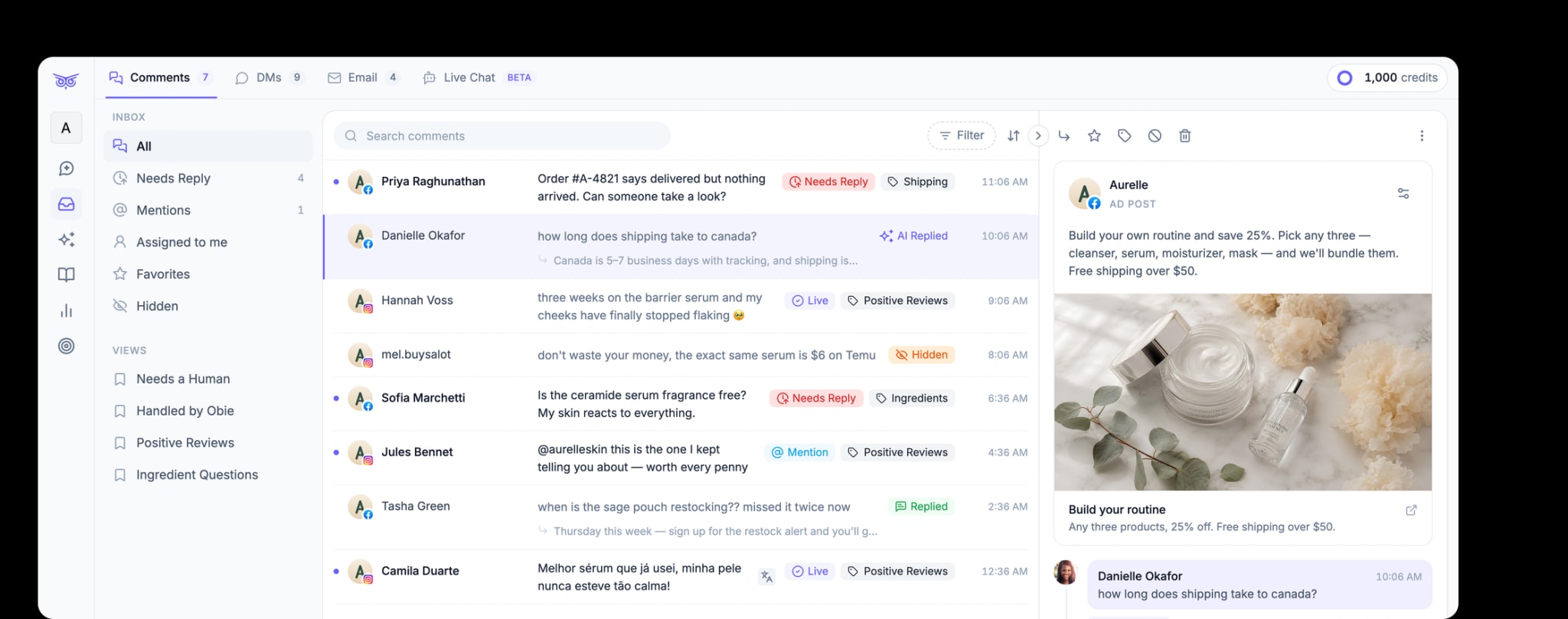
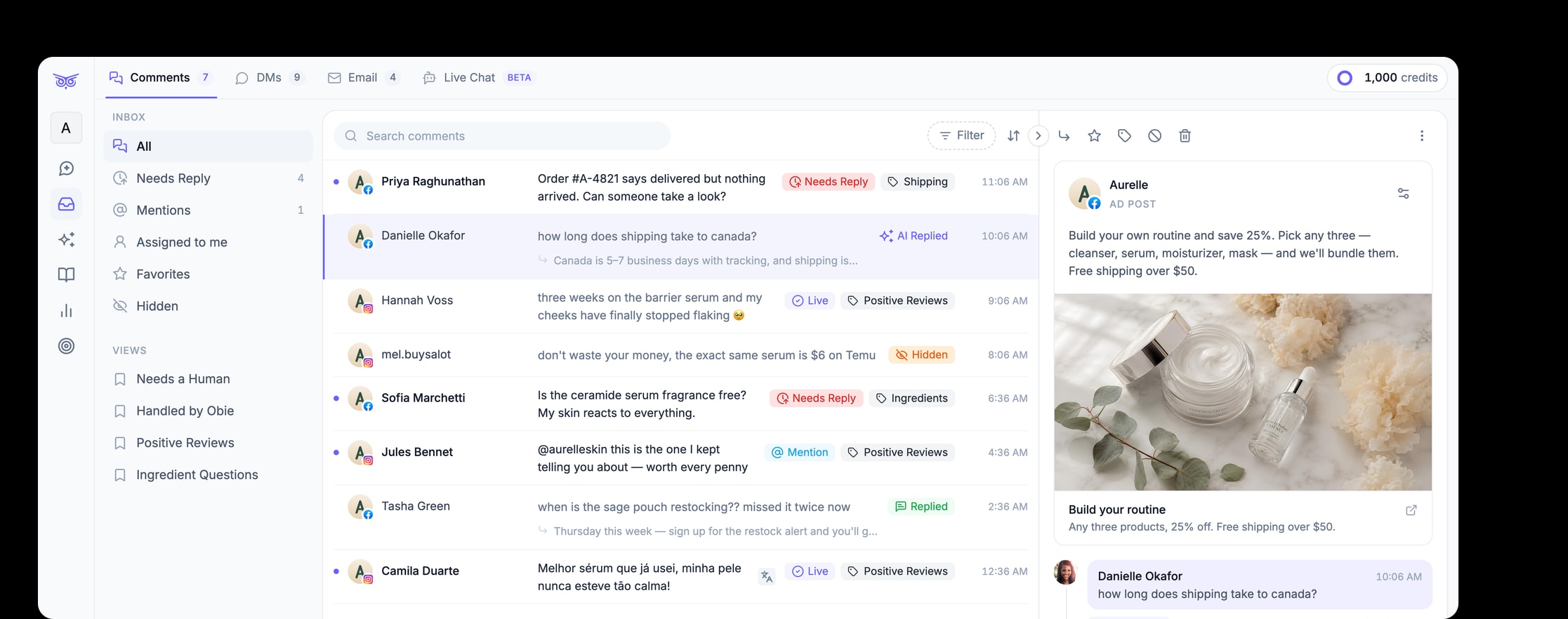
Brandwise is the strongest fit when social comments and DMs behave like customer-service tickets or buying conversations. It brings social conversations into one inbox and can apply different actions based on channel, message type, Smart Label, account, and automation scope.
The Brandwise automation guide documents actions that include drafting or sending replies, hiding comments, assigning team members, blocking users, marking conversations read, and deleting comments. It also recommends starting in draft mode and warns that destructive actions require careful review.
For an ecommerce team, the important difference is what happens after moderation. Brandwise can use approved brand knowledge and Shopify context so a workflow can move from “this is a shipping question” to a useful response or approved action. That makes it a better candidate when the desired outcome is resolution, not merely a clean comment section.
Choose Brandwise when: comments and DMs drive support or sales work; the team needs moderation and response automation together; Shopify context matters; or you want to begin with human-reviewed drafts and expand carefully.
Keep looking when: you primarily need publishing and scheduling, a fully outsourced moderation team, or a global enterprise governance suite.
2. NapoleonCat: best for a broader self-operated social suite
NapoleonCat's Auto-moderation uses configurable rules to reply, hide, delete, block, tag, assign, and notify across supported message types. Its current feature page covers Facebook and Instagram posts and ads, Instagram and Messenger DMs, TikTok, LinkedIn, and YouTube, with available actions varying by platform.
NapoleonCat also combines that rule system with a social inbox, publishing calendar, analytics, and reporting. This makes it a practical alternative when a social team wants one self-operated application for day-to-day management rather than a specialist moderation layer.
The evaluation should focus on exceptions. Recreate a profanity case, an innocent comment containing a blocked word, a customer complaint, a post with sudden volume, and a private message that needs assignment. Confirm the trigger priority, audit history, available action, and reversal path for each channel.
Choose NapoleonCat when: a social team wants rules, inbox work, publishing, and analytics in one product.
Keep looking when: ecommerce resolution context, managed human coverage, or enterprise-wide governance is the dominant requirement.
3. CommentGuard: best for focused Facebook and Instagram moderation
CommentGuard is deliberately narrower. Its current site centers on Facebook and Instagram posts, ads, stories, reels, comments, and DMs. It offers a unified inbox, bulk actions, filters, automated hiding or deletion, saved and automated replies, AI-drafted responses, team access, and moderation analytics.
A focused tool can be an advantage when Meta ads generate nearly all of the workload. The team has fewer surfaces to configure, and the buying decision can center on comment visibility, spam rules, private replies, response speed, and collaboration.
The same focus is also its boundary. If TikTok, YouTube, X, reviews, or broad listening are important, confirm whether another system will still be needed. Include that second tool and the handoff between them in the real operating cost.
Choose CommentGuard when: Facebook and Instagram comments and ads represent the clear majority of the problem.
Keep looking when: cross-channel moderation or deeper customer-service context is essential.
4. ICUC: best for a managed human moderation service
Software is not always the correct substitute. ICUC's services page presents social media moderation, community management, social listening, review management, regulated-industry support, consumer insights, and digital customer care. It also states that community-management coverage is available 24/7 throughout the year.
This model fits a brand that wants a provider to staff and operate the workflow instead of giving an internal team another queue. Human judgment can be especially important for crisis response, sensitive communities, regulated conversations, and engagement that cannot be reduced to stable rules.
The contract matters more than a public feature list. Define languages, staffed hours, response-time expectations, approval boundaries, escalation paths, evidence retention, crisis ownership, platform access, and what the provider may never post or remove without approval.
Choose ICUC when: the primary need is operational coverage and human community expertise.
Keep looking when: your team wants self-service software, direct product control, or automation economics for a narrowly defined workload.
5. Sprinklr: best for enterprise governance and unified customer experience
Sprinklr Social combines publishing, engagement, analytics, governance, automation, and AI in a broader enterprise platform. Its current materials emphasize role-based access, custom workflows, automated approvals, risk flagging, and connections between social media management, consumer intelligence, marketing, and customer service.
That breadth can be valuable when moderation crosses regions, agencies, care teams, legal reviewers, and brand owners. A rule is only one part of the system; permissions, approval paths, auditability, listening, reporting, and integration governance may be equally important.
It can also be too much system for a focused team. A successful enterprise platform needs administrators, implementation time, governance design, training, and ongoing ownership. Do not compare license scope alone—compare the operating model required to keep it useful.
Choose Sprinklr when: moderation is one component of a large, governed social and customer-experience program.
Keep looking when: one team needs a fast, focused comment-and-DM workflow.
How to choose between the final two
Shortlist by operating model first, then run the same test in both finalists.
Use a representative moderation pack
Include obvious spam, a legitimate negative review, a product question, a request containing private information, an ad comment, a multilingual comment, and an ambiguous joke. Add one high-risk example that must escalate without an automated public response. Record the expected action, owner, and escalation route for every example before testing.
Test actions, not classifications
Knowing that a comment is “negative” is not enough. Verify what the system does next: leave, reply, draft, move private, tag, assign, hide, delete, block, report, or escalate. Check whether a person can understand why the action happened and reverse it when appropriate.
Measure resolution and false positives
Track useful outcomes: customer questions resolved, harmful content handled within policy, conversations routed correctly, and legitimate comments preserved. Also review false positives and incorrect replies. A low queue count can hide a bad moderation policy.
Calculate the full operating cost
Include software, usage, seats, implementation, internal review time, managed-service hours, required second tools, and ongoing policy maintenance. The cheapest line item may create the most manual work.
Which BrandBastion alternative should you choose?
Choose the model that fits the work:
- Brandwise for ecommerce comments and DMs that need automation, moderation, and customer resolution.
- NapoleonCat for a broad, self-operated social media suite.
- CommentGuard for focused Facebook and Instagram comment management.
- ICUC for managed human moderation and community coverage.
- Sprinklr for enterprise governance across social, care, and insights.
If your team needs to turn social comments into support and revenue conversations—not just remove harmful content—see how Brandwise manages social engagement, then test Brandwise with the same representative moderation pack described above.