15 Instagram Auto-Reply Message Examples That Sound Human
Copy 15 Instagram auto-reply message examples for FAQs, after-hours support, orders, comments, and handoffs—plus a practical setup guide.
Updated July 22, 2026

The best Instagram auto-reply is short, specific, and honest about what happens next. It should answer a simple question when the answer is known—or acknowledge the message and route it to a person when it is not. It should never pretend that an automated acknowledgement has resolved a customer’s problem.
Here is a dependable general-purpose example:
Thanks for messaging [brand]. We received your note and a member of our team will reply during [business hours]. If your question is about shipping or returns, you may find the answer here: [help link].
That message works because it confirms receipt, sets a real expectation, and offers a useful next step. The 15 templates below cover more specific situations, including product questions, order help, comments, complaints, and after-hours messages.
What an Instagram auto-reply can do
“Instagram auto-reply” can describe several different workflows. Choosing the right one matters more than choosing clever wording.
- Instant or away acknowledgement: a fixed first response that confirms a new message and states when a person will reply.
- FAQ or keyword response: a fixed answer triggered by a question a person selects or by a word or phrase in their message.
- Contextual automated reply: a response generated from the message, conversation, and approved business information, then drafted for review or sent under defined rules.
The Meta business-messaging tools documented here support fixed greetings and away messages, FAQs, and custom keyword responses. Availability can vary by account and region. Meta Business Suite Inbox brings supported Instagram messages and comments into one inbox and supports common-question and keyword automations. Instagram also lets professional accounts display up to four frequently asked questions in chats, with optional automated answers.
Native automations are most useful when one predictable trigger should always receive the same response. They are not a substitute for reading an order problem, understanding a complaint, or checking whether a policy applies.
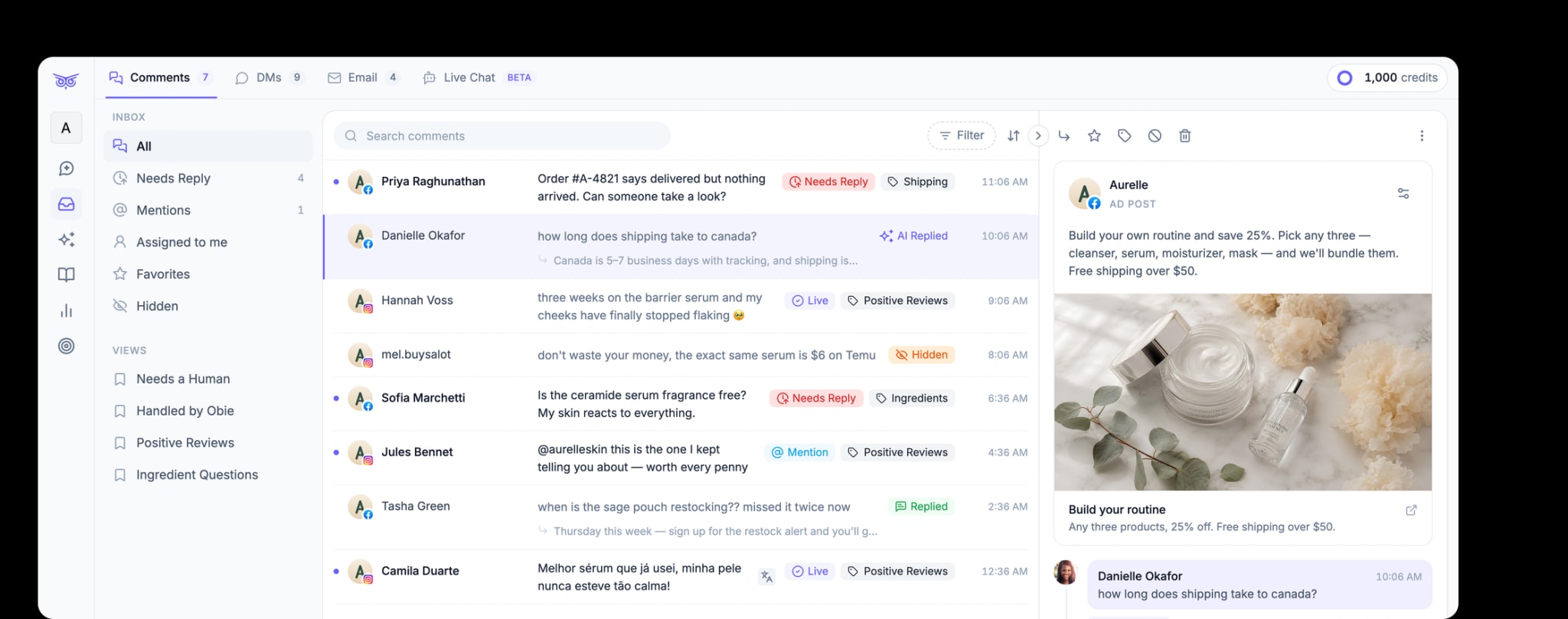
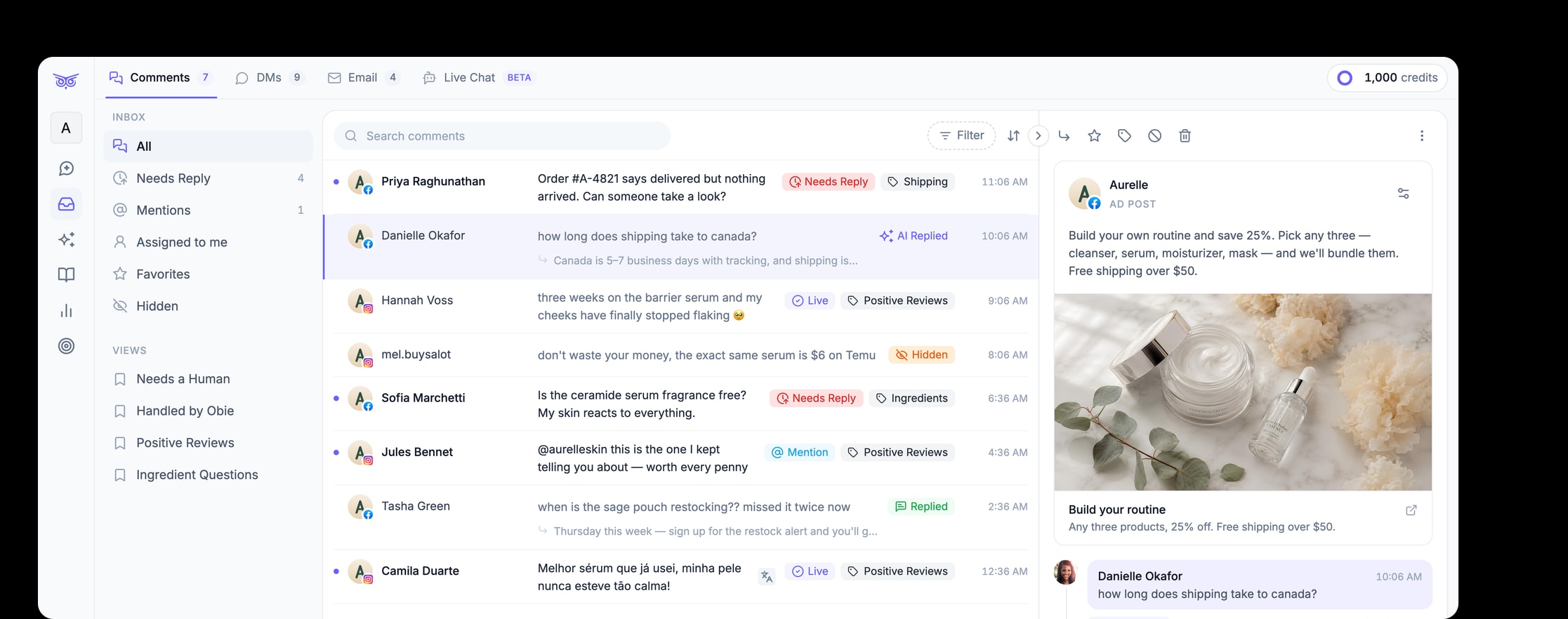
Brandwise addresses the contextual layer. It can use approved information about your brand to draft replies for review or automatically send relevant replies to comments and direct messages. When configured, low-confidence replies can be skipped, saved as drafts, or assigned to a team member. The practical difference is simple: a native keyword rule can send the same return-policy link whenever someone types “return”; a contextual workflow can distinguish a general policy question from a customer whose return has already been rejected.
15 Instagram auto-reply message examples
Replace every bracketed field before turning on a template. Only promise a response time your team can consistently meet, and never request passwords, payment details, or other sensitive information in a comment.
1. General first response
Hi! Thanks for contacting [brand]. We received your message and will reply within [response window] during [business hours].
Best for: A native instant reply or broad first-touch acknowledgement.
Customize: Add one useful help-center link only if it covers a large share of incoming questions.
2. After-hours message
Thanks for reaching out. Our team is offline right now and will be back at [time and time zone] on [day]. We’ll reply after we return. For common shipping and return questions, visit [help link].
Best for: An away message outside staffed hours.
Customize: Name the time zone. “Tomorrow morning” can mean different things to the customer and the support team.
3. High-volume response delay
We’ve received your message. Our current reply time is about [realistic timeframe] because of [launch/holiday/event] volume. There’s no need to send the same message again—we’ll respond in the order it arrived.
Best for: Temporary peaks when your normal response promise is no longer accurate.
Customize: Remove this automation as soon as the backlog clears.
4. Shipping-policy FAQ
We currently ship to [regions]. Standard delivery usually takes [published range] after the order ships. You can see current rates, destinations, and exceptions here: [shipping-policy link].
Best for: A selected FAQ or keyword such as “shipping.”
Customize: Use only information from your current public policy. Do not turn a general estimate into a promise for a specific order.
5. Return-policy FAQ
Our current return policy allows [plain-language eligibility summary]. Read the full policy and start a return here: [returns link]. If you already started a return and need help, reply with what went wrong—please don’t send payment information.
Best for: General “return,” “exchange,” or “refund policy” questions.
Customize: Keep exclusions and deadlines visible rather than hiding them behind a vague “easy returns” claim.
6. Product availability question
Thanks for asking about [product]. The latest availability is shown here: [product link]. If the option you want is unavailable, tell us the [size/color/model] and we’ll help you find the closest current option.
Best for: A product-specific keyword automation or contextual reply.
Customize: Do not claim an item is in stock unless the automation has a current source for inventory.
7. Sizing or compatibility question
We can help with that. Our [size/compatibility] guide is here: [guide link]. Tell us the [measurement/device/model] you’re comparing, and our team can help interpret the guide.
Best for: A common pre-purchase question that needs one more detail.
Customize: Avoid a definitive recommendation when the customer has not provided the information needed to make one.
8. Order-status handoff
We can help check your order. Please use [secure support route] or continue in this DM with your order number and the email used at checkout. Don’t post those details in a public comment.
Best for: Moving an order-specific question from a comment to a private support channel.
Customize: If this message is already in a DM, remove the instruction about moving channels. Ask only for the minimum information your team needs.
9. Damaged or incorrect item
I’m sorry your order arrived that way. Our team will review this with you. Please send your order number and a photo of the item through [private support route], and we’ll explain the available next step.
Best for: A private acknowledgement before a person reviews the order.
Customize: Do not promise a refund or replacement until the authorized workflow confirms it.
10. Public product-question comment
Yes—[concise answer supported by the product page]. You can find the full details here: [product link]. If you’re deciding between options, tell us what matters most and we’ll help.
Best for: An automated or drafted reply to an Instagram comment when the answer is public and verified.
Customize: Answer the question in the comment instead of replying only with “DM us.” Other shoppers may have the same question.
11. Public complaint acknowledgement
I’m sorry this has been frustrating. We’d like to understand what happened and help with the next step. Please send us a DM with [minimum identifying detail], and our team will review it.
Best for: A public bridge to a private investigation.
Customize: Refer to the actual issue when possible. Do not automatically hide a legitimate complaint simply because its sentiment is negative.
12. Safety or adverse-experience escalation
We’re sorry to hear about this and want to route it to the right team. Please stop using the product if you believe it is unsafe and contact us privately at [approved support route]. Our team will ask for the details needed to review your report.
Best for: A pre-approved acknowledgement followed by immediate human escalation.
Customize: Have a qualified owner review the language for your products and jurisdiction. The automation should not diagnose, debate the report, or offer medical advice.
13. Wholesale, partnership, or press inquiry
Thanks for thinking of [brand]. Please send your [company/publication], website, and a short description of the opportunity to [contact route]. The right team will review it and follow up if there’s a fit.
Best for: Routing a recognizable business inquiry without making a commitment.
Customize: Use separate destinations for wholesale, creator partnerships, and press when different teams own them.
14. Giveaway or campaign keyword
Thanks—here’s the [guide/link/offer] you requested: [destination]. [One-sentence eligibility or expiration detail]. If you have a question about it, reply here and our team can help.
Best for: A keyword automation tied to a clearly advertised campaign.
Customize: Make the trigger and terms clear in the post. Test the destination and expiration date before launch, then disable the automation when the campaign ends.
15. Language clarification
Thanks for your message. We can support [languages]. Would you like help in [option one] or [option two]?
Best for: A short clarification when language detection is uncertain.
Customize: Do not claim support for a language unless a person or a reviewed workflow can complete the conversation in that language.
How to set up Instagram automated responses
The exact labels in Meta’s interfaces can change, and some features vary by account or region. Use this as the durable workflow rather than relying on one screenshot.
- Confirm the account setup. Instagram messaging business tools require a professional account. Connecting that account to a Facebook Page lets authorized people manage Instagram messages and comments in Meta Business Suite.
- Open Meta Business Suite Inbox and find Automations. Make sure Instagram message access is allowed for the people who will manage the inbox.
- Choose one trigger. Start with an instant acknowledgement, away schedule, selected FAQ, or narrow keyword. Do not attach several overlapping rules to the same message on day one.
- Add a response and verify every fact. Check links, hours, policy language, destinations, and promised response times. A fixed automation will repeat an outdated answer perfectly until someone changes it.
- Test from an account outside your team. Test a matching message, a near match, and a message that should not trigger. Confirm that a person can still see and continue the conversation.
- Review real conversations. Look for duplicate replies, false triggers, unanswered follow-ups, broken links, and customers who interpret an acknowledgement as a resolution.
Meta’s own description of Business Suite Inbox automations includes greetings, away information, common-question responses, and custom keyword triggers. Availability is the source of truth: if a trigger is not present in the connected account, do not build a customer promise around it.
Native Instagram replies vs. Brandwise automation
Use a native fixed response when the trigger and answer are both predictable. Good examples include business hours, a shipping-policy link, or an after-hours acknowledgement. These workflows are fast to configure and easy to audit.
Use a contextual system when the response depends on what the person actually said, what was said earlier, which product or post is involved, or whether the case needs a person. Brandwise is designed for teams managing that higher-volume mix across comments and messages. It can draft replies for approval or automatically respond under the rules you choose, using the brand information you provide rather than a single generic template.
The two approaches can work together. A native instant reply can set expectations immediately; Brandwise can then classify the conversation, prepare a relevant answer, and apply your configured fallback when a reply has low confidence. Avoid configuring both systems to answer the same trigger automatically, or customers may receive duplicate and contradictory messages.
A five-point check before you turn on an auto-reply
Before publishing any Instagram auto-reply, confirm that:
- the trigger is narrow enough that the template makes sense every time;
- every policy, link, business hour, and response promise is current;
- the message clearly says whether it is an acknowledgement or an answer;
- private or sensitive cases have a defined handoff and owner;
- someone will review false triggers and follow-up messages after launch.
Start with one high-volume, low-risk question. Review the conversations it produces, improve the source information and wording, then add the next workflow. The goal is not to automate the most replies. It is to give more people a useful answer—and make sure the conversations that need judgment reach a person quickly.
If fixed Instagram rules no longer match the volume or context of your conversations, see how Brandwise manages social comments and messages. Start with one low-risk workflow, keep sensitive cases with a person, and expand only after reviewing real conversations.